From the Plastic Straw Ban: Decoding the Industrial Shift Behind Plastic-Free F&B Policies
在全球永續政策的推進下,塑膠吸管禁令與一次性餐具管制,正在成為各國餐飲政策最直接的切入口。餐飲業往往不是最後被要求改變的產業,而是最早被推到前線的那一群。這並非因為餐飲業「特別不環保」,而是因為它同時具備三個政策制定者最在意的特質:High frequency of use, high visibility, and a profound connection to everyday life.
When governments aim to make sustainability policies “visible, understandable, and actionable,” the food and beverage industry becomes a key point of entry.
Why has single-use tableware become the starting point for global policy?
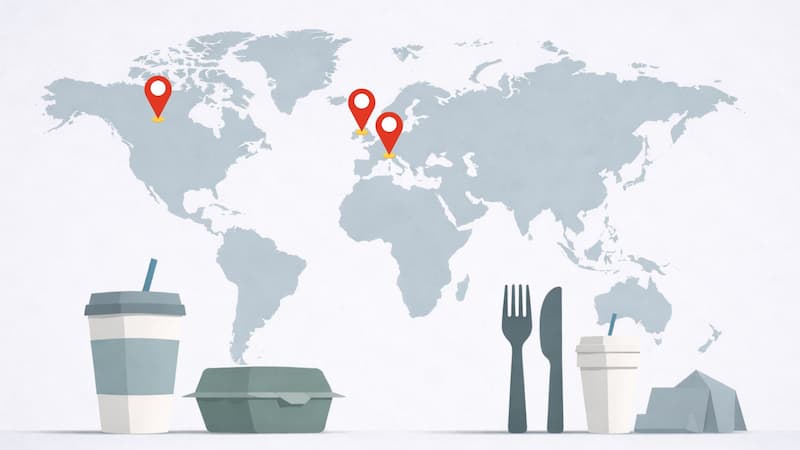
From the European Union and the United Kingdom to North America and select Asia-Pacific markets, one of the most consistent policy trends in recent years has been the progressive tightening of regulations on single-use tableware.
- Taking the European Union as a prime example, the《Single-Use Plastics Directive(EU 2019/904)》, passed in 2019, mandates that member states implement restrictive measures on common beach litter. This directive has since become the foundational regulatory framework for banning single-use plastic items worldwide.
- The UK is advancing on a dual track of "prohibitions + taxation" On one hand, it continues to restrict the supply of various single-use plastic items (with government guidelines being regularly updated). On the other, the Plastic Packaging Tax leverages fiscal policy to target plastic packaging with insufficient recycled content. The tax rate for the 2024–2025 fiscal year was set at £217.85 per tonne, and it is scheduled for another upward adjustment starting April 1, 2025, reaching £223.69 per tonne.
- Canada officially published the《Single-use Plastics Prohibition Regulations》on June 22, 2022, formally banning the manufacture, import, and sale of six categories of single-use plastic items—including straws and cutlery—while maintaining specific exemptions for flexible straws in certain contexts.
On the surface, these policies focus on plastic straws, stirrers, and cutlery; however, the objective extends far beyond addressing "individual items." Instead, they are pushing toward a more fundamental inquiry:
📌 一個產業,是否有能力在不依賴複雜後端處理的情況下,重新思考材料與使用方式?
The characteristics of single-use tableware leave this issue with nowhere to hide: they are defined by high-frequency use, low unit costs, and the extreme difficulty of recycling. Since these items are nearly impossible to "remedy" through end-of-pipe waste management, policymakers have strategically chosen them as the primary point of intervention.
The plastic straw ban has never been just about the straws themselves.
Plastic straws are often viewed as the symbol of anti-plastic movements, but within the context of policy-making, they serve more as a "Minimum Viable Test Unit."
For governments, straws possess three distinct characteristics: high substitutability, a relatively manageable impact on consumer experience, and the ability to serve as a rapid litmus test for an industry's capacity to pivot. This is precisely why the UK’s single-use plastic restrictions clearly delineate prohibited items for supply and sale alongside specific exemptions; it is not merely a symbolic declaration, but a set of rules designed for immediate, practical implementation.
換句話說:吸管被率先處理,並不是因為它「最重要」,而是因為它「the ultimate indicator of an industry's willingness and capacity to change」。當吸管被替換,接下來被檢視的,往往就是更大範圍的包材、製程與供應鏈結構。
When the focus of policy shifts from downstream waste management back to the source of the materials
A significant shift is occurring:
global sustainability policies are progressively moving away from "how to handle waste" and toward "why this waste is generated in the first place."
Policies like he UK’s Plastic Packaging Taxare designed not to encourage you to "recycle harder," but to force a structural adjustment of materials in the market by setting a "recycled content threshold" coupled with taxation. Canada’s Single-Use Plastics Prohibition Regulations (SUPPR) is even more direct: it imposes restrictions on the supply side for specific single-use plastic items, effectively forcing alternatives to become the market’s default choice.
For the food and beverage industry, this is no longer just an environmental issue—it is a practical operational challenge, because material selection now directly influences:
- Compliance Risk
- Supply Chain Stability
- Long-term Cost Structure(Including taxes and packaging strategies)
Why Sustainability is No Longer Just a PR Game for the F&B Industry
In this specific policy context, the meaning of sustainability for the F&B industry is undergoing a profound transformation:
"Sustainability is no longer just a 'brand enhancer'; it has gradually evolved into a core 'risk management capability'—the ability to make resilient choices even before policy directions are fully crystallized."
This explains the growing anxiety among many F&B brands: The challenge isn’t willingness, but a landscape of "exploding options, shifting rules, and global market inconsistency", making procurement and communication harder. The UK government’s approach—specifically outlining prohibited items while detailing situational exemptions—is a clear reflection of the immense complexity involved in policy implementation.
A deep understanding of policy is essential, forming the foundation for transformation.
Among all dimensions of sustainability, policy is often the most visible and undeniable signal. It clearly charts the course, yet it does not tell enterprises "how" to navigate the journey
📌 這正是餐飲業最需要補上的那段空白:learning to understand the underlying trends, rather than merely reacting to the bans.
Why start with the “Policy Section”?
In facing the immense complexity of sustainability within the F&B industry, we believe that a single perspective is insufficient to support long-term decision-making. Consequently, we have designed a Sustainable White Paper framework centered on the F&B sector, unfolding progressively across three strategic levels:
- Policy & Regulations
- Supply Chain & Material Structure
- Brand Communication & Market Trust
For now, we are starting with the "Policy" dimension—the most directional factor and the one with the greatest impact on practical decision-making—by consolidating and publishing our first 《Sustainability Policy White Paper》.
When you no longer wish to merely react to bans,
but seek to truly understand the direction of the future.
If you are thinking beyond "what is banned now"
and considering "which choices will become increasingly unsustainable" in the future,
this white paper is your starting point to understand evolving F&B sustainability trends.