Understanding Why F&B Sustainability Decisions Are Getting Harder: From Plastic Bans to Material Risks
在餐飲業的「永續轉型」過程中,市場上的選項前所未有地多,決策卻沒有因此變得更輕鬆。當每一種sustainable choice 都各自對應不同政策、成本與風險時,真正困難的往往不是執行,而是「判斷」。
📌 不是因為資訊不足,而是因為資訊過多,卻缺乏判斷依據。
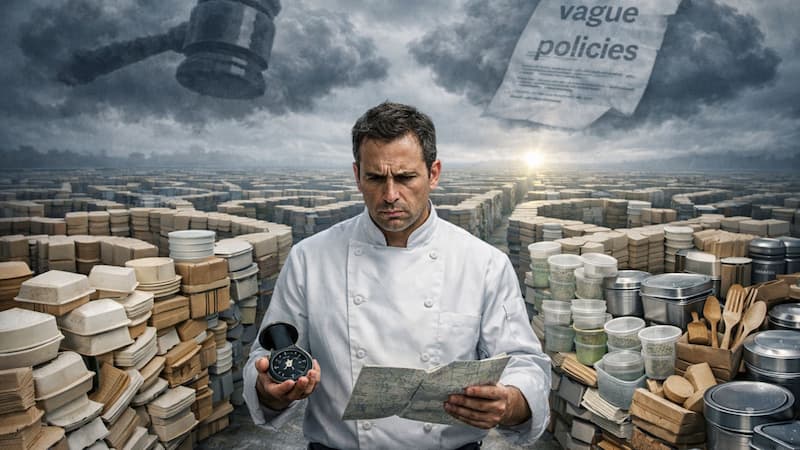
Why does an abundance of sustainability options make decision-making harder?
From a policy perspective, this is hardly surprising. Most international sustainability regulations do not prescribe which specific material a company "should use."
Instead, they define boundaries: specifying which items are restricted, which conditions must be met, and which scenarios still allow for exceptions
For instance:
- the European Union 《Single-Use Plastics Directive(EU 2019/904)》lists prohibited items but does not specify which alternative materials should be used.
- The UK’s Plastic Packaging Tax sets a threshold for recycled content rather than mandating specific packaging formats.
- Canada’s 《SUPPR (Single-use Plastics Prohibition Regulations)》 restricts market circulation of certain single-use plastics without providing standardized alternatives.
📢These policies collectively convey a single message:
Governments set the direction but don’t make the choices for businesses.
When policy only draws boundaries, the pressure naturally falls on the enterprise
For the F&B industry, this reflects a stark reality: "compliance" is no longer a clear or stable benchmark.因為今天合法的材料,可能只是「暫時還在政策灰區內」; 而明天政策關注的焦點,可能就會移到它身上。
This is precisely why many F&B operators are beginning to feel an implicit risk: even if there is no violation now, it is difficult to ensure that the current choice will remain valid and defensible in the years to come.
Why Materials Have Become the Critical Node for Risk Amplification
在前一篇文章中,我們談到政策開始追問材料來源。而在實際決策中,材料之所以關鍵,是因為它同時牽動三個層面:
- Policy Risk: Does the material align with the future direction of governance?
- Supply Chain Risk: Is there heavy reliance on specific processing technologies or cross-border systems?
- Post-Consumer Risk: Does the material rely on specialized recycling or disposal conditions to be truly "sustainable"?
當一種材料必須同時在這三個層面「被照顧」, 它就不再只是成本項目,而是一個風險單位。
Why "Legally Compliant Now" Does Not Equal "Stable in the Future"
從政策演進的角度來看,這其實是一個結構性問題。永續法規往往是「分階段推進的」:先處理最明顯的問題,再逐步往源頭收斂。因此,許多材料不是「被否定」,而是尚未輪到被檢視。
This explains why the following keywords are appearing with increasing frequency in policy documents:
- Traceability
- Recycled Content
- Extended Producer Responsibility (EPR)
- Supply Chain Due Diligence
這些並不是在描述產品,而是在為「未來的選擇設下判斷門檻」。
The real challenge of sustainability decision-making isn't value—it's time
For most F&B brands, the true pressure stems from the "Time Gap"
- The Market demands an immediate choice.
- Policy reveals its direction only in stages.
- Supply Chain adjustments often require a much longer lead time.
Under these conditions, a decision that seems reasonable in the short term can easily expose structural risks in the medium term.
This is why more and more enterprises are realizing:
📌 問題不在於選得夠不夠環保,而在於選擇是否撐得過時間。
So, how can the F&B industry make choices they "won't regret"?
There is no standard answer here, nor should there be.
However, observing international policy and market evolution reveals a common trend: Successful sustainability decisions are rarely about picking the "best" solution, but rather about avoiding the "most fragile" options.In other words, the focus isn’t on “predicting which solution will win,” but on “recognizing which choices are already coded into institutional risk.”
Why You Need a Framework, Not More Options
When options explode, true scarcity isn’t the product, but the "capacity for judgment".
This is precisely why, in organizing our F&B sustainability content, we chose to start with policy and gradually extend into materials and decision-making logic. Only by understanding how policy sets boundaries and how materials carry risk can an enterprise make relatively stable choices amidst such high uncertainty.
If you, too, have realized there are "no simple answers"
If your current bottleneck isn't about vision, but judgment
if it’s not about "whether to act, but "how to avoid acting wrongly"
Instead of chasing materials, prioritize building a foundation for understanding policy.
重複使用是環保的,但「前提是確實且多次」重複使用,才能抵銷產品從製造到廢棄的整個生命週期對環境的影響。如果為了環保而過度購買、囤積或不善加使用,反而會造成浪費。
重複使用是環保的,但「前提是確實且多次」重複使用,才能抵銷產品從製造到廢棄的整個生命週期對環境的影響。如果為了環保而過度購買、囤積或不善加使用,反而會造成浪費。
指的是企業或品牌,透過「誇大、模糊或不實」的行銷手法,讓消費者誤以為其產品或服務對環境非常友善,但實際上對環境的效益卻微乎其微,甚至根本沒有。